Agriculture Bureau,New Taipei City Government
 Agriculture Bureau,New Taipei City Government


Bali Wazihwei Nature Reserve
In 1994, the Council of Agriculture under the Executive Yuan officially designated Wazihwei as a Nature Reserve under the Cultural Heritage Preservation Act, covering approximately 30 hectares.
Wazihwei is located in Bali District on the left bank of the Tamsui River, at coordinates E120.24°, N25.10°. It faces the Tamsui District and Datun Mountain Range across the river. The name "Wazihwei" originates from the curved inlet terrain at the river mouth. In earlier times, most residents made a living by fishing; today, only a few fishing boats remain in operation or docked here.
Due to sediment accumulation from the river, the area has formed a lagoon-type wetland that curves inland. The influence of daily tides has enriched the soil with organic matter, fostering high biodiversity. This typical estuarine ecosystem, comprising Kandelia obovata, mudskippers, fiddler crabs, and waterbirds, was designated a nature reserve in 1994. Historical records indicate that the mangrove area was only 4.4 hectares in 1986, expanding to 5.9 hectares by 1994 and 7.9 hectares by 2011, and then to 10 hectares by 2024, with the expansion generally occurring from south to north.
The mangrove forest in Wazihwei marks the northernmost boundary of the global Kandelia obovata distribution, holding significant biogeographic value. The mangroves shelter a variety of associated species, including crabs, mollusks, fish, and birds. Their presence enables these animals to hide, rest, forage, and even reproduce, making the reserve an ideal location for observing species up close and personal. Crab-watching and bird-watching are among the reserve’s key academic and tourism resources.
Wazihwei Nature Reserve serves as an excellent outdoor classroom for mangrove wetland ecological education. Visitors can follow a boardwalk surrounding the reserve or cycle along the bike path, guided by interpretive signs with pictures and text.
Please note that the tidal flats within the reserve are muddy and subject to unpredictable tides. Do not enter the protected area without authorization from the competent authority. Unauthorized entry poses significant safety risks and may result in a fine ranging from NT$30,000 to NT$150,000.
While observing nature, please also keep the following in mind: Use only your eyes to observe and your heart to appreciate. Do not use tools to dig, capture, or harm any animals or plants—respecting life is the core of environmental learning.
Plan your visit according to the tidal schedule and bring the appropriate gear for the best observation experience. The optimal time to observe intertidal species is typically three hours before or after low tide.
Wetland organisms are sensitive and easily startled. Observe quietly, squat or sit calmly, and move gently to increase your chances of being "surrounded" by crabs and mudskippers. Do not disturb the natural environment or litter. “Take nothing but pictures, leave nothing but footprints.”
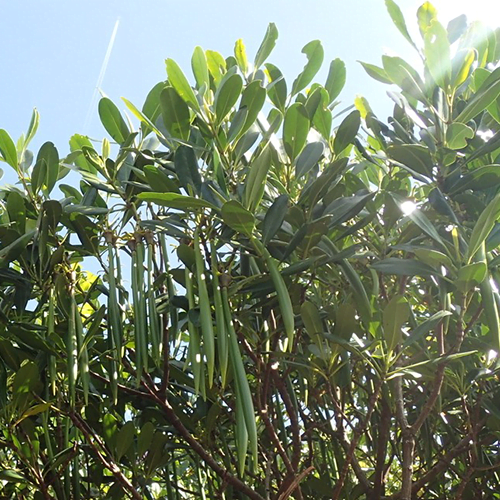
Also known as Kandelia, Water Banyan, Red Teruntum, or Red Mangrove, Kandelia obovata is the most northerly distributed mangrove species in Taiwan. It is a small evergreen tree of the Rhizophoraceae family, specially adapted to saline and tidal environments, having evolved structures such as viviparous seedlings and stilt roots.
The plant can grow up to five meters tall and blooms from May to June. Its seeds germinate directly on the parent tree and mature from March to June of the following year, eventually dropping and floating away to root in suitable environments. Among mangrove species, it is relatively cold-tolerant and is generally believed to offer benefits in soil stabilization, coastal protection, and erosion control.
Mangrove plants play a vital role in wetland ecosystems as primary producers, providing food and shelter for various animal species and safeguarding coastlines. Balancing conservation with economic development to achieve sustainable coexistence is a shared responsibility for all of us.