Agriculture Bureau,New Taipei City Government
 Agriculture Bureau,New Taipei City Government


Fairy Lily
Basic Information
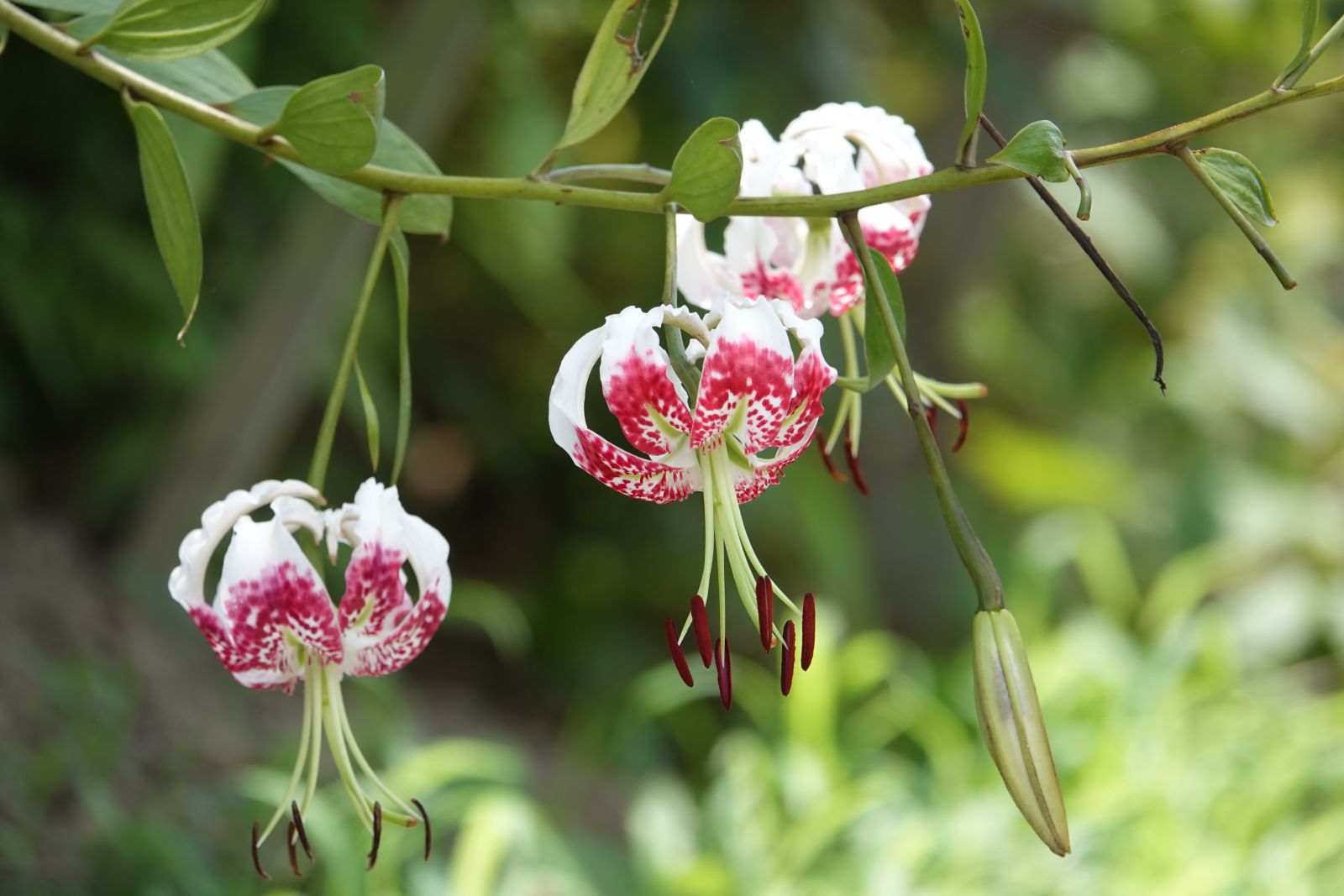
The Fairy Lily (Lilium speciosum Thunb. var. gloriosoides) is a native lily species of Taiwan, belonging to the genus Lilium in the Liliaceae family. It is a variety of the Lilium speciosum.
According to the 2004 bulletin article "Natural Distribution and Variation of the Fairy Lily" published by the National Museum of Natural Science, this species naturally occurs in East Asia, between latitudes 25°N to 35°N and longitudes 105°E to 135°E, including Taiwan, mainland China, and Japan.
Due to geographical isolation, many varieties have emerged, one of which is the Fairy Lily. It is found only in the coastal and inland mountain areas of New Taipei City and Keelung at elevations between 200 and 600 meters. Its flowers are white with red spots, the petals are strongly recurved with wavy edges, and it blooms between August and September.
One of its native habitats is in Pingxi District, New Taipei City, where it grows on sun-facing rocky slopes exposed to strong northeastern monsoon winds. It relies on mist and dew for moisture and coexists with Miscanthus transmorrisonensis and Taiwan arundo. Locals have given it poetic nicknames like "Angel’s Wings" and "Fairy of the Cliffs."
Due to its reputed medicinal value in treating skin conditions and shingles, as well as its striking floral beauty, it has been heavily overharvested. Combined with habitat destruction, this species now faces the threat of extinction. The International Union for Conservation of Nature (IUCN) has listed it as a critically endangered plant species.
Origin and Process of Restoration
Restoration efforts began in 2006 with collaboration between the Taipei County Government (now New Taipei City Government), the Pingxi Township Farmers' Association, Pingxi Elementary School, and others. The goal was to establish Pingxi—already famous for its sky lanterns—as the “Hometown of Lilies.”
However, due to insufficient public awareness of conservation, many of the restored plants and seedlings were stolen, resulting in considerable setbacks. Although the seedlings were frequently taken and increasing the population proved difficult—especially since the lily takes at least three years to bloom from seed—those involved in the project continued out of a deep connection to the land and a sense of responsibility for the Fairy Lily. The restoration initiative has since been rooted in education to promote conservation awareness and inspire the public to cherish this beautiful flower.
Recent Restoration Achievements
In recent years, in addition to continuing wild habitat restoration, the Agriculture Bureau has placed greater emphasis on community participation and educational outreach.
Today, visitors can not only see wild Fairy Lilies blooming naturally along the cliffs of Xiaozishan Trail and at Lingyan Temple, but also witness the results of community restoration efforts at sites such as Zidong Community, Pingxi Elementary School, Huoshaoliao Farm, Blue Magpie Café, and the riverside trail near Lingjiao Railway Station. Shops along Pingxi Old Street have also joined in and supported the restoration campaign.
It is hoped that this collective care and effort will resonate in everyone’s heart, encouraging more people to cherish and protect Taiwan’s precious native plant species.