Agriculture Bureau,New Taipei City Government
 Agriculture Bureau,New Taipei City Government


Mile-a-minute Weed (Mikania micrantha)
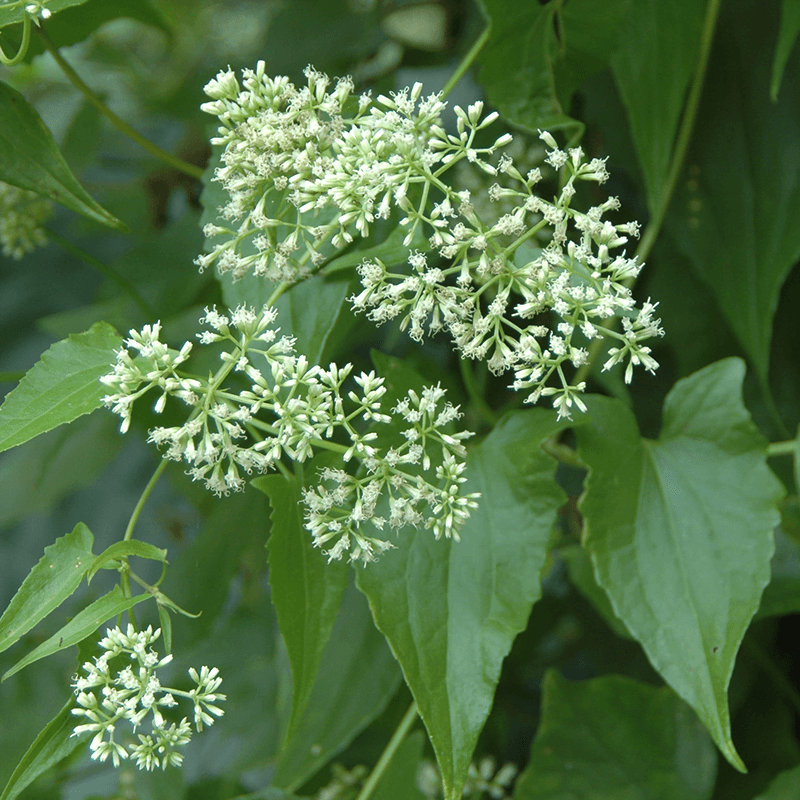
Mile-a-minute weed, native to Central and South America, thrives in moist environments and is highly phototropic. It is a perennial vine.
Its stems are green when young and turn light brown with multiple constriction marks as they mature. The leaves are broadly triangular to ovate with several shallow, wavy serrations along the edges, and 3 to 5 main veins extending from the base. It blooms in winter, producing numerous small white flowers. The plant is prolific in seed production, dispersing up to 170,000 seeds per square meter, mainly spread by wind, animals, and insects.
Additionally, every node of its creeping stem that touches the soil can produce roots and new shoots. Adventitious roots can also grow between nodes. This strong reproductive ability makes it difficult to eradicate, which is why the government must monitor and control it continuously every year.
Due to its aggressive reproduction, smaller plants or those sprawling along the ground or in shrubbery should be removed entirely by pulling them out with their roots. If the weed has already climbed trees, the vine should be cut 50 centimeters above the ground before flowering. The upper portion will naturally dry out and die, so it is only necessary to thoroughly remove the surface-level vines and roots.
The removed plant material should be sealed in black plastic bags for decomposition or dried on open concrete surfaces before disposal. Otherwise, any leftover vines on site may lead to secondary spread, undermining the effectiveness of control measures.
In New Taipei City, mile-a-minute weed is mainly found in Shulin, Sanxia, Tucheng, Yingge, Wugu, and Linkou districts. It tends to invade areas with sufficient sunlight and poor management, such as low-altitude canal embankments, abandoned farmland, and forest edges.
The Agriculture Bureau has documented all infested sites and conducts annual follow-up and removal. The goal for small-scale infestations is complete eradication, while for large-scale or difficult-to-clear sites, the objective is to prevent further spread to nearby areas.