Agriculture Bureau,New Taipei City Government
 Agriculture Bureau,New Taipei City Government


Sacred Ibis (Threskiornis aethiopicus)
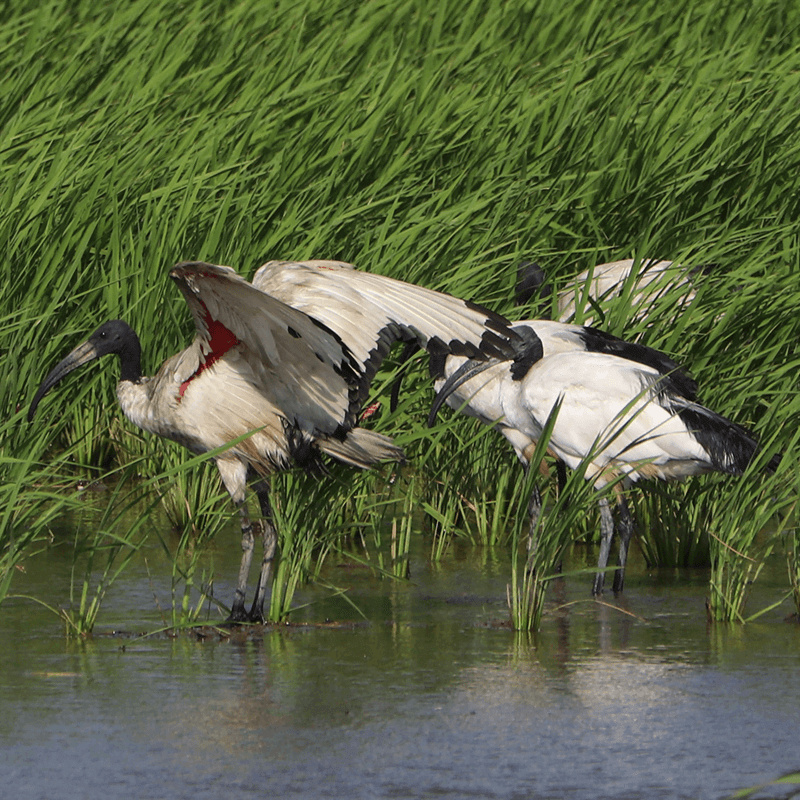
The Sacred Ibis (Threskiornis aethiopicus) is native to the Nile region in Africa and is distributed across areas south of the Sahara, East Africa, Ethiopia, and South Africa. After being introduced to Taiwan, it became an invasive bird species that poses a serious threat to native bird populations and the natural ecosystem.
The Sacred Ibis was first observed in the wild in 1984 in Guandu, Taipei City, and later spread to the west coast from Yilan to Pingtong. To prevent further population expansion, the Agriculture Bureau implements "report and management" and "reproductive control" measures, while the Forestry Bureau(now renamed as Forestry and Nature Conservation Agency) is responsible for "adult bird removal."
From 2010, the Agriculture Bureau has commissioned professional teams to carry out nest monitoring, searching, surveying, and reproductive control of the Sacred Ibis within its jurisdiction. Nest site surveys primarily involve regularly monitoring previously recorded nesting areas and continuing to search for potential nesting zones. Regular surveys are conducted in eight districts of New Taipei City (Tamsui, Bali, Wugu, Luzhou, Sanchong, Banqiao, Xinzhuang, and Taishan) to identify Sacred Ibis aggregation hotspots.
From 2022 to now, there are not new nest and reproductive record in New Taipei City, but only few dozens of adult birds.