Agriculture Bureau,New Taipei City Government
 Agriculture Bureau,New Taipei City Government


Spot-legged Tree Frog (Polypedates megacephalus)
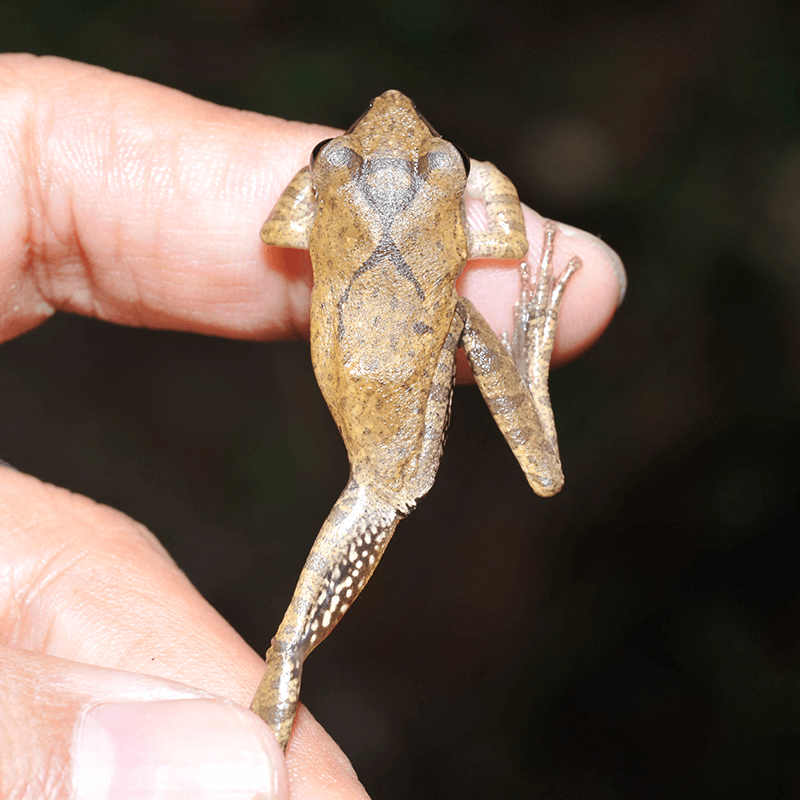
The spot-legged tree frog (Polypedates megacephalus) is native to South China, Hong Kong, Hainan Island, India, and the Indochina Peninsula. It is a medium to large-sized frog with a brown back marked with longitudinal stripes, spots, or X- or Y-shaped patterns. The inner thighs and flanks are covered with small yellow speckles. Its call consists of a series of rapid “gek-gek-gek” sounds or occasional “ga-ga” croaks.
It is nocturnal and rests during the day in trees, shrubs, or drainage pipes.
The primary breeding season is from April to September, characterized by high temperatures and heavy rainfall. The species prefers shaded aquatic habitats for reproduction. Each foam nest contains about 300 to 800 eggs, attached to grasses or trees along the banks, making it easy for the species to spread via ornamental plants.
The spot-legged tree frog was likely introduced to Taiwan through the importation of aquatic plants. According to surveys conducted by the Forestry Bureau, it tends to invade areas with frequent human activity, such as parks, wetlands, and cultivated lands. It is now distributed across low altitude plains and hills in western Taiwan.
As an arboreal species, it faces little competition in low altitude environments. Its diet mainly consists of insects, but it also preys on coexisting lizards and frogs. It has even been observed feeding on the tadpoles and eggs of other frog species, posing a significant threat to native species.
If left this invasive specy unmanaged, it could cause a major impact. on native ecosystems and biodiversity.
To prevent further spread, the Agriculture Bureau continues to collaborate with the Forestry and Nature Conservation Agency of the Ministry of Agriculture on the Invasive Species Removal Program. In partnership with Professor Yi-Ru Yang’s team from National Dong Hwa University, the Bureau is working to reduce reproduction niche by altering habitats, strengthening public awareness , and encouraging horticultural businesses doing self-inspections, for the purpose of reducing the possibility of further spread.