Agriculture Bureau,New Taipei City Government
 Agriculture Bureau,New Taipei City Government


Wulai Rhododendron
Basic Information
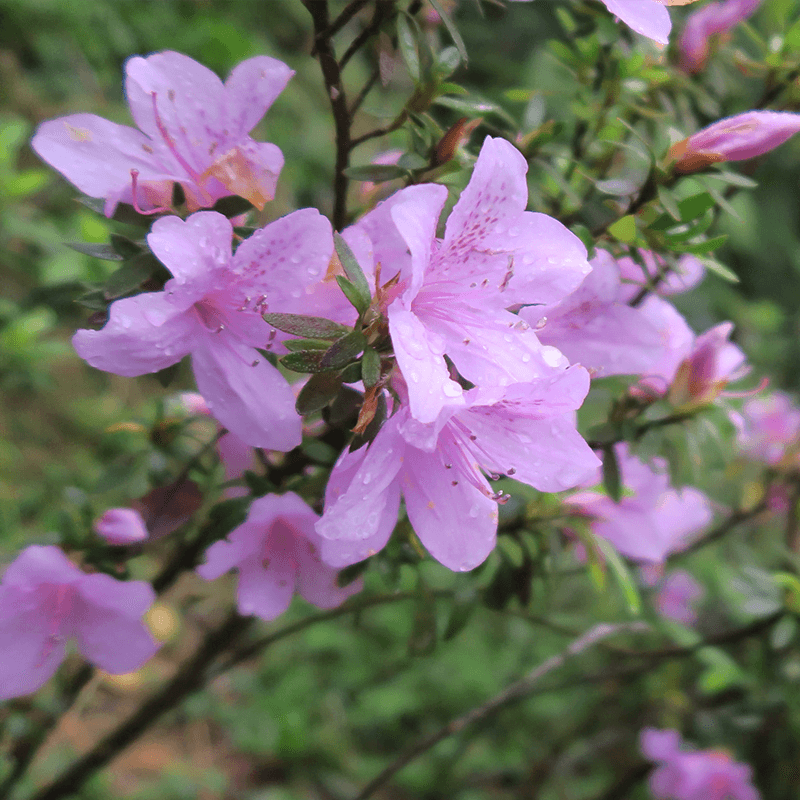
The Wulai Rhododendron (Rhododendron kanehirai Wilson), also known as Willow-leaf Rhododendron or Kanehira’s Rhododendron, is an evergreen shrub of the Ericaceae (heath) family and is endemic to Taiwan. The leaves are narrowly lanceolate and semi-papery, covered on both sides with reddish-brown bristles. It’s a terminal flower and is funnel-shaped, with colors ranging from peach pink to light pink, lavender, and reddish-purple. It has ten stamens and elongated, oval-shaped capsule fruits.
It is the only native Taiwanese rhododendron species that grows in subtropical low-elevation riparian habitats, often found in crevices of rocks along riversides. Its native habitat was located along the banks of the Beishi River, particularly around Qiangou and Luditang.
After the completion of the Feitsui Reservoir in 1984, its natural habitat was submerged. Since then, there have been no known records of wild populations, and only a few transplanted and cultivated individuals exist. It is currently classified as Extinct in the Wild (EW).
Origin and Process of Restoration
As the Wulai Rhododendron’s native habitat lies in New Taipei City, the Agriculture Bureau began considering restoration efforts in 2001.
Since 2002, the Bureau has collaborated with the Taiwan Endemic Species Research Institute, which preserved genetic material at its low-elevation experimental station in Wushikeng, and with the Forestry and Nature Conservation Agency to carry out restoration efforts.
The Bureau continues to promote the restoration project by propagating seedlings through cuttings at the Xiaogetou Nursery in Shiding and transplanting them along Huan Shan Road in Wulai, as well asand behind Yunhai Elementary School. The aim is to rebuild the population through human efforts and restore the beauty of this native species.
Restoration Achievements
With stable propagation techniques in place, the Agriculture Bureau has, in recent years, introduced the Wulai Rhododendron to the public by planting it around scenic areas near the Feitsui Reservoir—also known as Taiwan’s Thousand Island Lake—including the Zhitan–Tutan Road, Route 47-1, Erbazi Botanical Garden in Xindian, Dalan Suspension Bridge, and the Wulai Waterfall Park along Huan Shan Road. These plantings are carefully maintained in hopes that the shrubs will grow well and thrive.
These tranquil locations offer stunning views of the reservoir. In spring, visitors can not only enjoy the scenery but also admire the elegant beauty of the Wulai Rhododendron up close.
Additionally, to increase genetic diversity and enhance the species’ adaptability in the wild, the Bureau has worked with experts to cultivate seedlings from seeds. Five-year-old seed-propagated saplings have been planted at Shiding High School and are being gradually introduced into natural environments. Through ongoing observation and adaptive management, the goal is for these plants to bloom healthily in the wild once again.